
Looked after properly, a soundproof curtain will perform for years. Get it wrong, and a single trip through the washing machine can permanently damage part of its sound insulation.
The good news is that routine care is very simple and takes a few minutes every few weeks. Here is the short version first, then all the detail.
⚡ The essentials in 20 seconds
Dry clean only . Never machine wash, never iron. Every four to six weeks vacuum with a soft brush attachment. Dry cleaning every two to three years is enough, or sooner if you get a stain. Never pull on the fabric when taking the curtain down or moving it.
Why soundproof curtains cannot go in the washing machine
Unlike an ordinary curtain, a soundproof curtain is not a single layer of fabric. It is built from several layers of different densities : a heavy mass layer, an absorbing layer and a face fabric, adding up to 950 g/m² at around 1 cm thick.
Three parts of a wash cycle can damage that construction directly:
- The spin cycle. This is the biggest risk. Centrifugal force twists and shifts the layers so they can come apart, leaving the curtain rippled or bubbled.
- Warm water. Heat changes technical materials and makes them shrink unevenly. If a made to measure curtain ends up too short, gaps open at the edges and sound gets through more easily.
- Harsh detergents. These attack the fibres and the layers themselves, weakening the acoustic performance over time.
There is also a practical issue: weight. A 3 x 2.5 m curtain weighs around 7 kg dry, and almost twice that soaked. A domestic machine is simply not built for that load.
⚠️ The damage is permanent
Once a soundproof curtain has been damaged in the washing machine, it generally cannot be put right. Layers that have separated do not bond again as they dry, and the loss of noise reduction can be permanent. This is the one mistake to avoid at all costs.
Routine care: vacuuming is enough
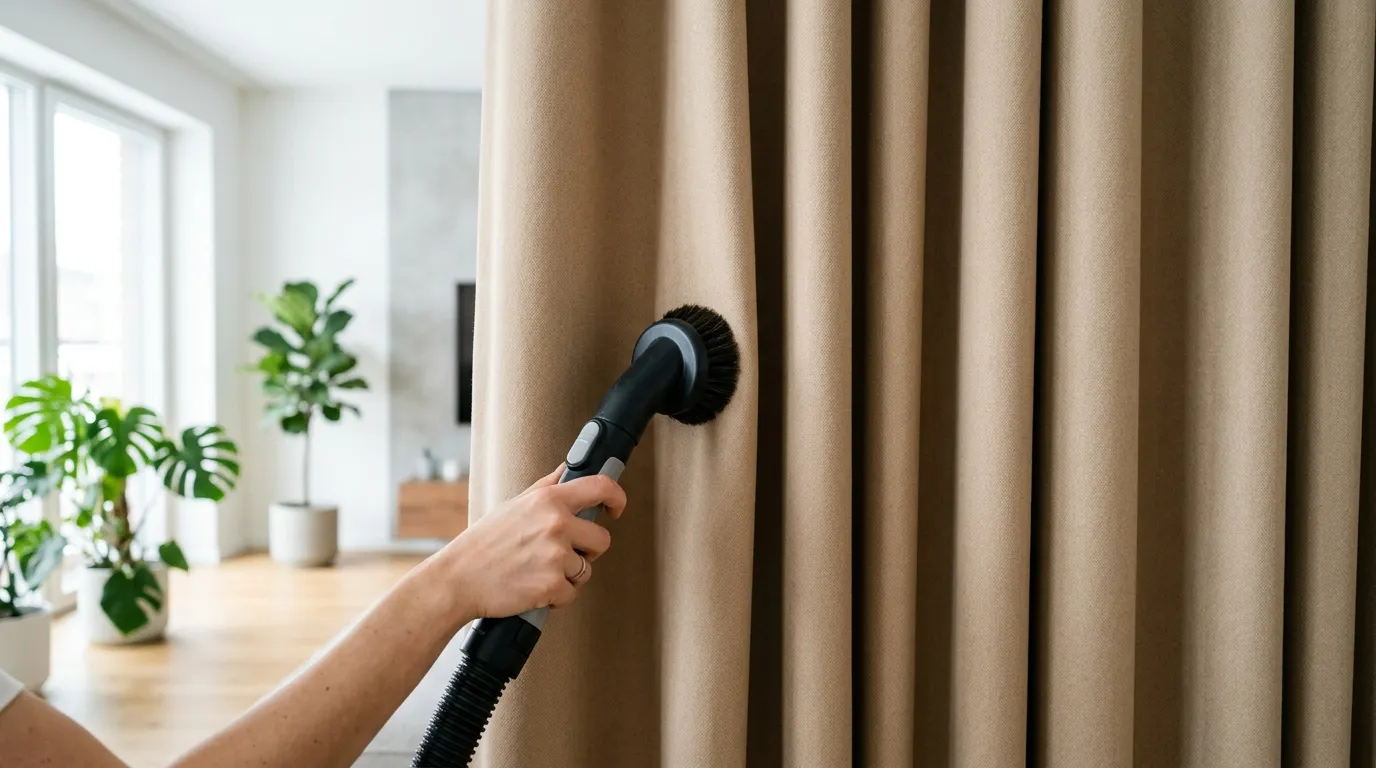
In practice, about 90% of caring for a soundproof curtain comes down to one thing: vacuuming.
Dust naturally works its way into the fibres of a dense fabric. A heavy curtain with deep folds has a lot of surface area for it to settle on. Over time dust dulls the colour, holds onto smells and stiffens the fabric.
- Use a soft brush attachment , never a narrow crevice tool directly on the fabric.
- Turn the suction downif your vacuum allows it, so the fabric is not pulled into the nozzle.
- Work from top to bottom in vertical passes, following the folds.
- Do not forget the bottom and the hem, where most of the dust settles.
- Vacuum both sides , every other time.
In an average home, doing this every four to six weeksis enough. With pets, a flat on a busy road or an open plan kitchen, once a month is better.
It is also worth airing the room. Pull the curtain aside and open the window for 20 minutes now and then. This matters most in bedrooms, where fabrics pick up moisture overnight.
Dealing with stains: what to do and what to avoid
Act fast: a fresh stain is far easier to lift than one that has dried in.
| Situation | Do this | Avoid |
|---|---|---|
| Spilt liquid | Blot straight away with a dry, absorbent cloth | Rubbing, which pushes the liquid deeper into the layers |
| Light stain | Dab gently with a barely damp cloth and cold water | Stain removers, bleach, solvents or household cleaners |
| Grease stain | Take it to a dry cleaner and tell them what the stain is | Washing up liquid or degreaser straight onto the fabric |
| Large or old stain | Professional dry cleaning | Cleaning with water |
| After cleaning | Let it air dry while hanging | Hairdryer, radiator or long spells in direct sun |
The rule of thumb: as little water as possible and no harsh products. Our curtains are made without harmful chemicals and are 100% non toxic. Shop bought stain removers can damage the layers, so leave them well alone.
Dry cleaning: when and how
Dry cleaning is the only suitable way to deep clean. It lifts dirt without water, so the fibres do not swell and the layered construction is left intact.
How often? For normal use at home, dry cleaning every two to three years is plenty. A curtain that gets vacuumed regularly needs no more than that. In kitchens, smoking areas, busy studios or commercial spaces, once a year makes sense.
What to tell the dry cleaner . These few points prevent most problems:
- It is a multi-layered soundproof curtain , not an ordinary decorative curtain.
- It weighs 950 g/m² and is around 1 cm thick , so their machine needs to handle that weight.
- It must not be hot pressed or ironed.
- It should be returned hanging , not folded, to avoid permanent creases.
One detail worth knowing: have all the panels in a room cleaned at the same time. Fabric changes slightly over time and with exposure to light, so cleaning only some of them can leave a visible difference in colour.
Getting creases out: never iron
Your curtain may arrive with creases from the packaging. That is completely normal and usually sorts itself out.
Just hang it and wait. At 950 g/m², the curtain's own weight pulls it flat. Most creases disappear within a few days, and certainly within a week. It is the simplest method and the gentlest.
If a crease is stubborn, you can use a steamer, held well back and never touching the fabric, moving slowly from top to bottom. Test it first low down, on the side facing the wall.
🚫 Never iron
The direct heat of an iron can damage the inner layers and leave permanent shiny marks. The same goes for hot pressing at a dry cleaner, so say so clearly when you drop the curtain off.
Taking down, rehanging and storing
After machine washing, poor handling is the next biggest cause of damage. A curtain weighing several kilos, hanging from a handful of eyelets or hooks, takes a lot of strain.
- Support the weight as you take it down rather than pulling to free the eyelets. Large panels are best handled by two people.
- Never pull on the fabric itselfto open or close the curtain. Take hold of the edge or the first fold instead, never the middle of the panel.
- Check the pole or track once a year. Loose fixings no longer spread the weight evenly and can distort the top of the curtain.
- For seasonal storage , a room divider you do not need in summer, for instance, roll the curtain around a tube rather than folding it, and keep it flat, dry and out of the light.
One last thing people forget: sunlight. Like any fabric, a curtain permanently facing south will fade slightly over time. It does not affect the acoustic performance. If looks matter to you, on a room divider seen from both sides for instance, darker shades tend to age more discreetly.
Frequently asked questions
Can you machine wash a soundproof curtain?
No. Our curtains are dry clean only. A soundproof curtain is not simply fabric, it is several bonded layers of different densities. The drum action, warm water and above all the spin cycle can pull those layers apart. The curtain distorts and loses its sound insulation for good.
How often should a soundproof curtain be cleaned?
In most homes, vacuuming every four to six weeks is enough. Dry cleaning is usually only needed every two to three years, or sooner if you get a stain or a smell. In kitchens, smoking areas or flats on busy roads, clean more often.
Does dry cleaning affect the acoustic performance?
No, as long as it is done properly and not too often. Unlike machine washing, dry cleaning leaves the layered construction alone. A curtain thick with dust actually gets heavier and stiffer over time, which spoils the way it hangs.
Can you iron or steam a soundproof curtain?
Never iron one, as direct heat can damage the inner layers. In most cases you will not need to: once hung, the curtain's own weight of 950 g/m² smooths the creases out within a few days.
In short
Caring for a soundproof curtain comes down to three habits: vacuum every four to six weeks, dry clean every two to three years and never use the washing machine or an iron. That is usually all it takes for your curtains to keep their up to 27 dB of noise reduction for the long run.
Not sure about a stain, or has your dry cleaner asked a question about the panels? Drop us a line. We reply within 24 hours, seven days a week, and we know these materials inside out.
Not got a soundproof curtain yet? A 4-in-1 curtain with up to 27 dB of noise reduction
Made to measure to the centimetre. 950 g/m², 1 cm thick, 100% blackout, thermal insulation and reduced reverberation. Made without harmful chemicals and 100% non toxic.
